
This documentation is currently under development and subject to change. It reflects outcomes elaborated by 5G-MAG members. If you are interested in becoming a member of the 5G-MAG and actively participating in shaping this work, please contact the Project Office
CAMARA: Application Profiles API
Description
The “Application Profiles” API enables developers to share essential information about their applications that is relevant for network and CAMARA APIs decision-making. Currently, it focuses on defining network quality thresholds and compute resource requirements needed by the application. This foundation will expand to include additional information based on requirements from other CAMARA APIs, making it a central point for capturing what the application needs are.
Used in the context of:
This API enables defining, reading, and managing application requirements,including:
- Network quality thresholds (latency, jitter, loss, throughput)
- Compute resource thresholds (CPU, GPU, memory, storage)
Information: https://camaraproject.org/application-profiles/ and https://github.com/camaraproject/ApplicationProfiles/
The API definitions can be obtained here: https://github.com/camaraproject/ApplicationProfiles/tree/main/code/API_definitions
Relation of APIs
Application Profiles API
- POST /application-profiles with the request body containing user-defined network quality thresholds. Used to define network monitoring intents for optimal end user application experience. Response is an
applicationProfileId. - PATCH /application-profiles/{applicationProfileId} - Update the complete set of network quality thresholds for an application with the new set of thresholds to ensure good end user experience
- GET /application-profiles/{applicationProfileId} - Read an Application Profile
- DELETE /application-profiles/{applicationProfileId} - Delete an application profile
Parameters
- Network Quality Thresholds
packetDelayBudget- the maximum allowable one-way latency between the customer’s device and the gateway from the operator’s network to other networks. The end-to-end or round trip latency will be about two times this value plus the latency not controlled by the operatortargetMinDownstreamRate- the target minimum downstream rate.targetMinUpstreamRate- the target minimum upstream ratepacketLossErrorRate- the exponential power of the allowable error loss rate 10^(-N). For 5G network the 3GPP specification TS 23.203 defines the packet error loss rate QCI attribute.jitter- this requirement aims to limit the maximum variation in round-trip packet delay for the 99th percentile of traffic, following ITU Y.1540 standards. It considers only acknowledged packets in a session, which are packets that receive a confirmation of receipt from the recipient (e.g., using TCP).
- Compute Resources
targetMinCPUtargetMinMemorygpuVendorTypegpuModelNametargetMinGPUtargetMinGPUMemorytargetMinEphemeralStoragetargetMinPersistentStorage
Workflow for a media application creating an Application Profile
A user of a media application would like to create and Application Profile with the network quality thresholds for the application. An example figure is shown using the Applicaiton Profile in the context of Connectivity Insights. The following steps are executed:
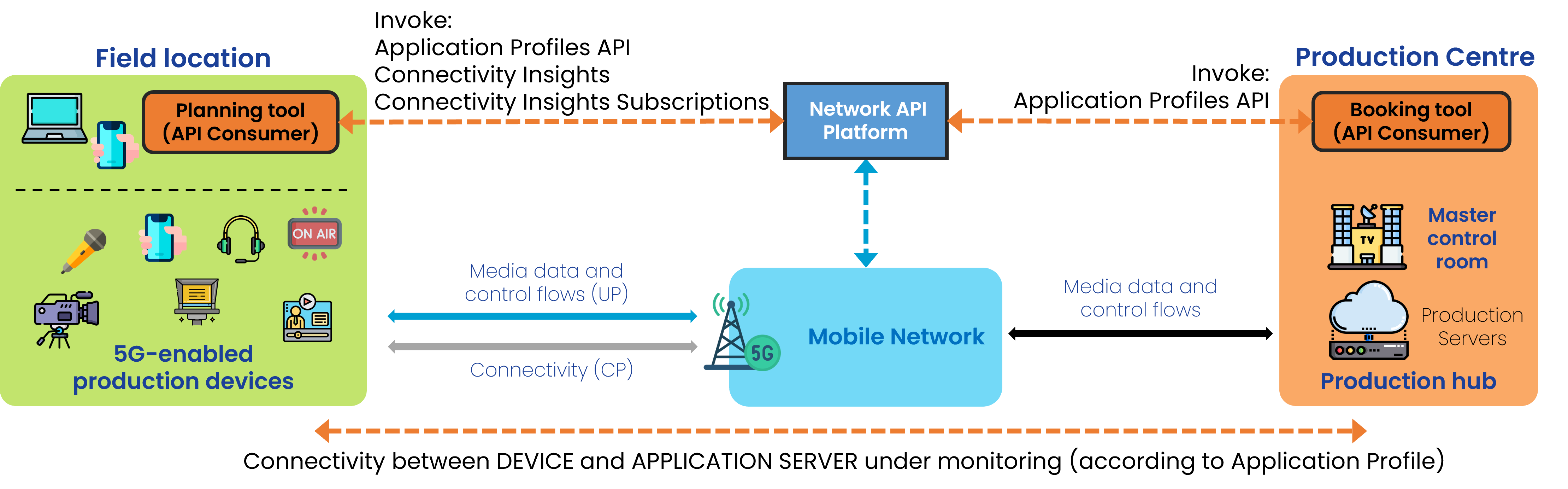
Step 1: Creation of Application Profile
- Create an application profile using the Application Profiles API with POST /application-profiles and with the request body containing user-defined network quality thresholds.
Further steps
- The Application Profile created can be used by other APIs.
5G-MAG’s Self-Assessment
The APIs is likely to be invoked well before the actual use of the network with the required values of performance and compute resources. It is the understanding that the Application Profile is a list of parameters to be monitored on the link indicated between device and AS once inoking other APIs passing the ApplicationProfile as body. Once an applicationProfileId is obtained, it can be used by other APIs.
Potential improvements and/or suggestions:
- the list of parameters and unit/accuracy should be checked for typical media applications. The parameters are a subset of
qosProfilewith additional compute resources. Harmonize? - Packet delay budget defined between device and cloud server? UPF? When invoking Connectivity Insights with such profile and indicated device and AS, how would this relate?
Application Profiles API Usage
Create a profile which represent the network demands of an application
With POST /application-profiles
{
  "networkQualityThresholds": {
    "packetDelayBudget": {
      "value": 12,
      "unit": "Minutes"
    },
    "targetMinDownstreamRate": {
      "value": 10,
      "unit": "Bps"
    },
    "targetMinUpstreamRate": {
      "value": 10,
      "unit": "Bps"
    },
    "packetLossErrorRate": 3,
    "jitter": {
      "value": 12,
      "unit": "Minutes"
    }
  },
  "computeResources": {
    "targetMinCPU": 0.5,
    "targetMinMemory": {
      "value": 10,
      "unit": "Kb"
    },
    "gpuVendorType": "Nvidia",
    "gpuModelName": "string",
    "targetMinGPU": 1,
    "targetMinGPUMemory": {
      "value": 10,
      "unit": "Kb"
    },
    "targetMinEphemeralStorage": {
      "value": 10,
      "unit": "Kb"
    },
    "targetMinPersistentStorage": {
      "value": 10,
      "unit": "Kb"
    }
  }
}
Type of response: An applicationProfileId
{
  "applicationProfileId": "3fa85f64-5717-4562-b3fc-2c963f66afa6",
  "networkQualityThresholds": {
    "packetDelayBudget": {
      "value": 12,
      "unit": "Minutes"
    },
    "targetMinDownstreamRate": {
      "value": 10,
      "unit": "bps"
    },
    "targetMinUpstreamRate": {
      "value": 10,
      "unit": "bps"
    },
    "packetlossErrorRate": 3,
    "jitter": {
      "value": 12,
      "unit": "Minutes"
    }
  }
}